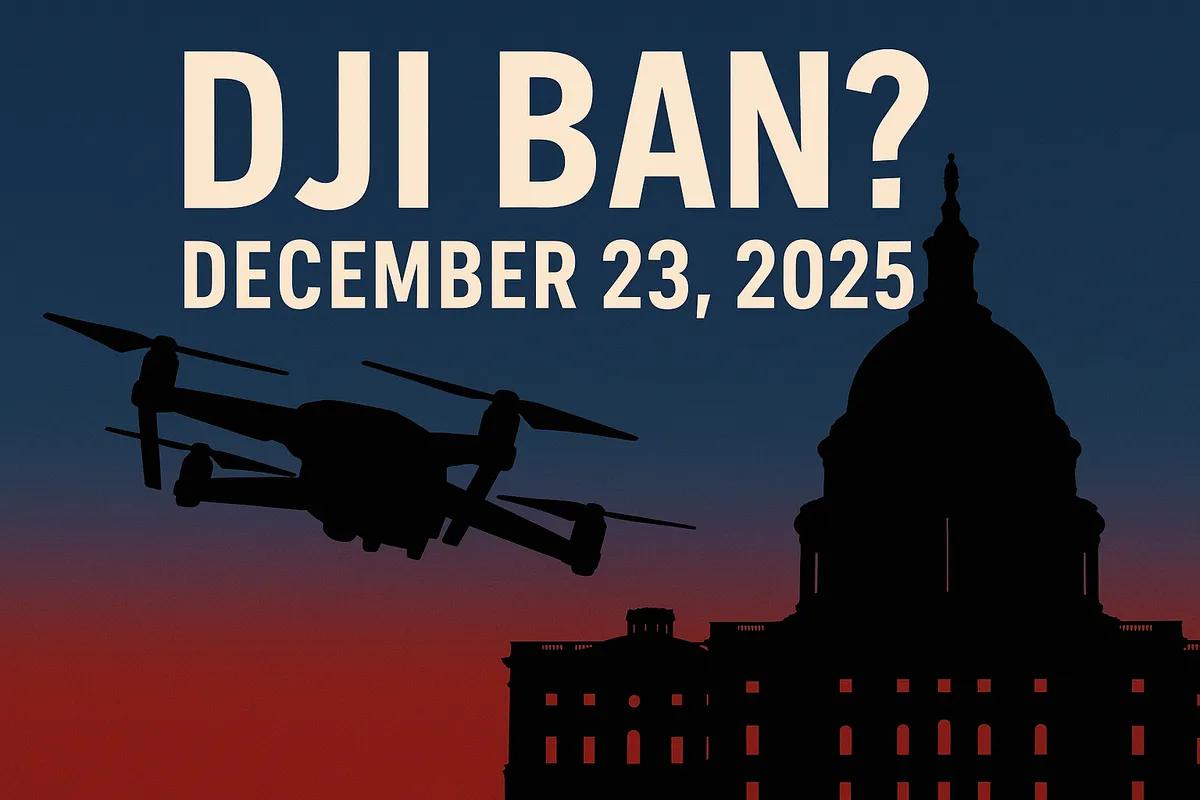
DJI Ban in the U.S.: What the December 2025 FCC Covered List Ruling Actually Did
For most of 2025, DJI owners were asking the same questions: Is DJI getting banned in the USA? Will my drone still fly? Should I buy parts now? Those were forecasts then. They have answers now.
The short version: the action that landed was not about confiscating drones or grounding current pilots. It centered on the FCC’s Covered List under Section 1709 of the FY2025 National Defense Authorization Act (NDAA). Because no U.S. agency completed the security review the NDAA called for, the listing took effect by the December deadline — and it hit new product approvals, new imports, and new US sales hardest, while leaving existing, already-authorized hardware legal to own and operate.
What the “DJI ban” actually means
On December 22, 2025, the FCC’s Public Safety and Homeland Security Bureau added DJI and Autel Robotics — and, in a first-of-its-kind move, all foreign-produced uncrewed aircraft systems (UAS) and UAS critical components — to the FCC Covered List. The Covered List is the FCC’s roster of communications and video-surveillance equipment deemed a national security risk.
The trigger was the mandate in Section 1709 of the FY2025 NDAA: a U.S. national security agency was supposed to audit DJI (and Autel). No agency completed that audit within the one-year window, so by the deadline the listing went through — backed by a related “National Security Determination” issued by an executive-branch interagency body.
The practical effect is narrower than “drones are illegal.” Equipment on the Covered List cannot obtain new FCC equipment authorizations, and that authorization is exactly what’s required to import, market, and sell most wireless devices in the U.S. Crucially, the listing does not prohibit the import, sale, or use of device models the FCC had already authorized before the cutoff.
What changed now that DJI is on the Covered List
1) New DJI products are blocked from launching in the U.S.
This is the most concrete fallout. Because new authorizations are off the table, recently announced DJI gear has launched globally but cannot be sold through normal US channels. Confirmed examples since the listing took effect:
- Osmo Pocket 4 (announced Apr 16, 2026) — blocked from US sale
- Lito 1 / X1 (Apr 23) — blocked from US sale
- Mic Mini 2 (Apr 28) — blocked from US sale
- Osmo Mobile 8P (May 7) — blocked from US sale
- Pocket 4 Pro (May 14) — blocked from US sale
Not everything was caught: the Avata 360 (Mar 26) made it to the US, and the flagship Mavic 4 Pro is available domestically only via the gray market. For a running, model-by-model picture of what you can and can’t legally buy stateside, see our US availability hub.
2) New imports and sales keep tightening
In its Ninth Circuit filings, DJI quantified the damage: roughly 14 existing products with voided FCC authorizations, 25 planned 2026 launches shut out of the US market, and a projected $1.56 billion loss for the calendar year. The squeeze is real, and it compounds over time as more new models are introduced abroad.
Will your current DJI drone stop working?
No. If your DJI equipment was authorized before the cutoff, it remains fully legal to own and fly, and it did not get “bricked” on the deadline. Adding a device to the Covered List does not retroactively ban hardware the FCC previously approved.
The friction isn’t deactivation — it’s lifecycle. The real questions for owners are about availability of new units, spare-parts supply, and long-term service logistics as the US channel narrows.
What about firmware, app updates, and repairs?
This is where the news got better than the December forecasts feared. In May 2026, the FCC’s Office of Engineering and Technology (public notice DA 26-454) extended the waiver that lets already-authorized DJI and Autel devices keep receiving firmware and software updates through at least January 1, 2029 — not a 2027 cutoff.
- The waiver covers security patches, vulnerability fixes, bug fixes, and compatibility updates, and was expanded to include more substantial Class II permissive changes.
- The FCC effectively conceded that cutting off security patches would be worse than the ban itself.
- Important limit: the waiver applies only to already-authorized equipment. It does not approve new DJI products and does not remove DJI from the Covered List.
So existing fleets have a clear, multi-year runway for security and maintenance updates. Spare parts and DJI Care service remain less predictable, since those depend on the same narrowing import channel.
DJI’s court fight and the security audit
DJI didn’t accept the listing quietly. On February 20, 2026, it filed a petition for review in the U.S. Court of Appeals for the Ninth Circuit (No. 26-1029), challenging the Covered List addition. Rather than push for an immediate merits ruling, DJI asked the court to hold the case in abeyance, with a status report due around November 2026 — so as of mid-2026 the case is effectively paused.
In April 2026, the Department of Defense filed opposition, citing classified intelligence — which DJI and Autel countered rests on secret evidence they can’t see or rebut.
On the technical side, DJI commissioned an independent U.S. security firm, OnDefend, to audit its systems. The assessment (engagement Oct 2025–Mar 2026, findings released May 28, 2026) tested the Air 3S and Matrice 4E across software, hardware, and RF, and reported zero critical, high, or medium-risk findings — no backdoors, no data sent outside the U.S., and no viable hijacking pathways. OnDefend notes it was a point-in-time assessment, so future firmware would still need ongoing review.
What DJI owners should do now
If you fly recreationally:
- Keep perspective: your existing drone is legal to fly and will keep getting security updates through at least 2029.
- Don’t panic-buy, but if you rely on a specific current model, buying from existing authorized US stock while it lasts is reasonable — new units of newer models may simply never reach US shelves.
If you fly professionally (Part 107) or rely on DJI for paid work:
- Build a continuity plan now: stock the spares and batteries you’ll need, since replacements and repairs may take longer as the channel tightens.
- Consider redundancy for critical operations (backup aircraft, payload alternatives, or a secondary platform).
For everyone:
- Track which models are still US-buyable on our US availability hub, and watch the Ninth Circuit case — the next real signal lands around the November 2026 status report.
FAQ
Is DJI banned in the USA right now?
Not in the sense of being illegal to own or fly. As of June 2026, DJI is on the FCC Covered List, which blocks new equipment authorizations — so new models can’t be imported or sold through normal US channels. Already-authorized drones remain legal to buy from existing stock, own, and operate.
What happened on December 23, 2025?
Around that NDAA deadline, with no required security audit completed, the FCC added DJI (and all foreign-produced drones and critical components) to its Covered List on December 22, 2025, restricting new US product authorizations.
Can I still fly my DJI drone?
Yes. Existing authorized DJI equipment is still legal to fly, and the FCC has authorized continued firmware and security updates for that equipment through at least January 1, 2029.
Will DJI win its FCC lawsuit?
Unknown. DJI’s Ninth Circuit petition is currently in abeyance with a status report expected around November 2026. The DoD has opposed it citing classified intelligence, while an independent OnDefend audit released in May 2026 found no critical, high, or medium-risk security issues.
Related Articles
The Sky's Not the Limit: What's Happening in the World of DJI Right Now
DJI's 2026 has been a flood of new gear — and a hard split between what ships worldwide and what US buyers can legally get. Here's the state of play.